




































byAmerican Heart Association
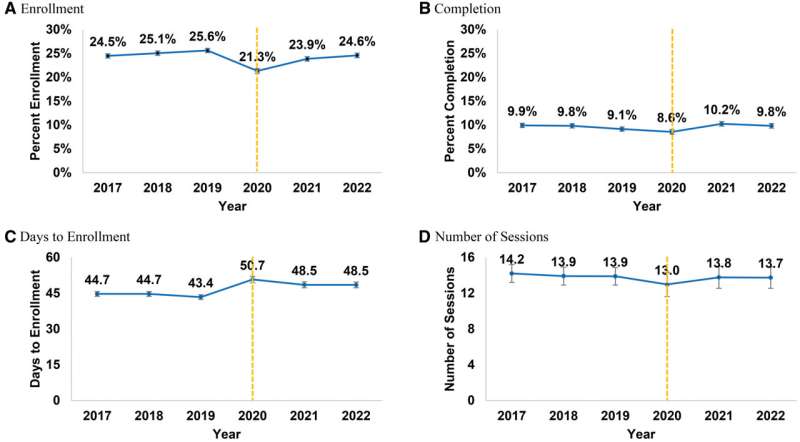
Predicted average cardiac rehabilitation (CR) metrics by year among commercially insured individuals aged 18 to 64 years with a CR-qualifying event between 2017 and 2022, MarketScan Commercial Claims and Encounters (CCAE, 2017–2023; A through D. Credit:Circulation: Cardiovascular Quality and Outcomes(2025). DOI: 10.1161/circoutcomes.125.012067
To understand the benefits of cardiac rehabilitation, you can trust decades of research—or listen to Taelur Littlejohn's story.
She was 28 when, shortly after giving birth, she had a devastating heart attack that nearly took her life. She spent months in the hospital, and it was months more before she was strong enough to even startcardiac rehab. In her first sessions, she could barely walk on a treadmill for a few minutes.
Three years later, Littlejohn can walk 5 miles around her Arlington, Texas, neighborhood. Cardiac rehab, she said, played a big part in making her heart strong again.
"Honestly, I feel like it was one of the best things that I've ever done," she said.
She's right, experts say.
"Cardiac rehab is a critically important part of the spectrum of cardiovascular care," said Dr. Laurence Sperling, the Katz Professor in Preventive Cardiology at Emory University School of Medicine in Atlanta. But it's also "underappreciated, underutilized and underrecognized" by physicians and patients alike.
Sperling, a preventive cardiologist who founded the Emory Center for Heart Disease Prevention, co-wrotea study, which was published inCirculation: Cardiovascular Quality and Outcomes, showing that, in the U.S., less than a quarter of eligible people younger than 65 enrolled in cardiac rehab. Of those who did, less than 10% completed the recommended sessions.
Sperling, who has written extensively about cardiac rehab, said the data regarding its benefits is "extremely powerful."
Cardiac rehab is often thought of as being mostly about exercise, Sperling said, but it's much more. It's a comprehensive, medically supervised program designed to help people recover after a heart attack, bypass surgery, valve surgery,heart transplantor other cardiac procedure.
Although programs vary, some of the core components, as spelled out in an American Heart Associationscientific statementpublished inCirculationin 2024, are:
The proven benefits of cardiac rehab put it on par with the importance of medications such as statins or beta-blockers in preventing a second heart attack.
As highlighted in thescientific statementreleased in October, people who participate in cardiac rehab are 42% less likely to be readmitted to the hospital after six to 12 months. They also have a lower risk of dying from a heart attack or other cardiovascular issues.
That statement, published in Circulation, noted that in terms of overall mortality risk, women see even more of a benefit from cardiac rehab than men.
The health benefits flow from many sources, said Sperling, who served as the executive director of Million Hearts, a Centers for Disease Control and Prevention/ Centers for Medicare & Medicaid Services initiative that sought to prevent a million heart attacks, strokes and other cardiovascular events in the U.S. within five years.
Exercise,healthy eatingand quitting smoking are essential to heart health. Cardiac rehab goes beyond that, he said,
Cardiac rehab is underused overall, and particularly among women and racially or ethnically underrepresented groups, Sperling said. Rates are low even among people with insurance. Many causes have been identified. Some of those he listed include:
"Thankfully, we are learning more about hybrid models—home-based models of cardiac rehab—and the possibilities of delivering cardiac rehab in other ways," Sperling said.
He considers cardiac rehab essential care for people recovering from cardiac issues. "Bottom line, they tend to do better in terms of their quality of life. They tend to get back to their usual activities of life more quickly, but also in a more meaningful way."
Littlejohn, a member of the American Heart Association's 2025 Go Red for WomenClass of Survivors, knows the value of cardiac rehab firsthand.
Her heart attack—a rare spontaneous coronary artery dissection, or SCAD—nearly took her life shortly after she gave birth to her third son in January 2022. Emergency triplebypass surgerysaved her, but she would spend almost three months in the hospital.
Littlejohn had physical therapy in the hospital and more at home, but she was so weak she couldn't climb stairs—or hold her infant son. Getting up to go to the bathroom left her out of breath. "If it was larger than a water bottle, it was too much for me to lift."
Six months after her heart attack, she was cleared to start cardiac rehab. Things started slowly. Literally, with the treadmill at its lowest setting, she said. "I couldn't even do that for like three or five minutes."
Often, she would be the last person to leave the center, while the staff, which was monitoring her heart rate and blood pressure, waited with her for her vital signs to return to a safe zone before releasing her.
The process was "mentally and emotionally challenging" for Littlejohn, who used to run track and described herself as a "gym girl."
And making arrangements could be a hassle. It was summertime, and her two oldest children, now 11 and 13, had to join her at the rehab center. "There were times where I felt like a little overwhelmed with it," she said, "but I knew it was something that I really needed to do."
The nurses encouraged the kids to cheer their mom on while they worked out with her.
Littlejohn also was motivated by the knowledge that her heart wouldn't get better unless she pushed it. And bit by bit, she did get stronger. She marked little milestones, like being able to climb seven steps at a time without pausing to catch her breath.
Although herheart attackwasn't related to her lifestyle, she took advantage of classes about healthy food. And she learned about exercises she could do at home after rehab was over.
The best part, Littlejohn said, was working with the nurses and other staff. "They were very supportive, patient and informative, and I feel like that helps a lot."
After a year in rehab, the payoff was measurable: A key measure of her heart's pumping ability had tripled from its lowest point. And while she can run only in short bursts, "I can get on the treadmill for an hour a day" at a much higher setting.
So she would tell anybody who has been referred to cardiac rehab to do it. It "did play a big part in my heart getting back."
More information: Lisa M. Pollack et al, Cardiac Rehabilitation Trends Among Commercially Insured Adults in the United States, 2017–2023, Circulation: Cardiovascular Quality and Outcomes (2025). DOI: 10.1161/circoutcomes.125.012067 Journal information: Circulation , Circulation
Provided by American Heart Association









Post comments