




































by Beth Miller,Washington University in St. Louis
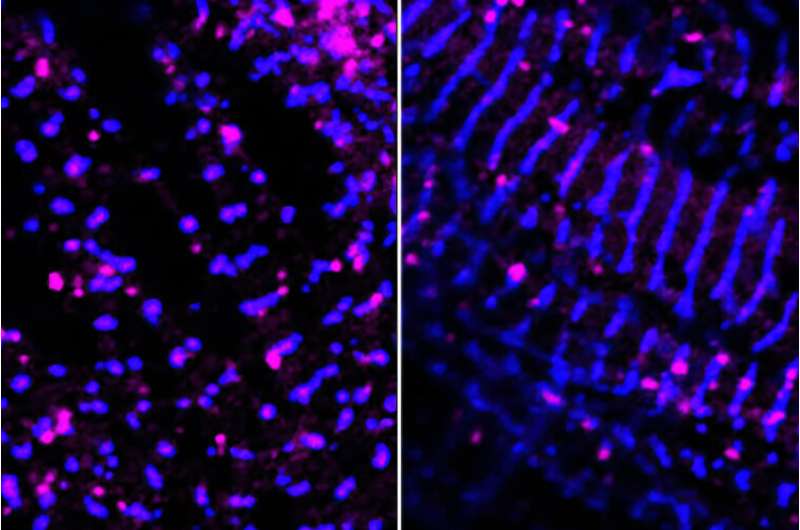
A patient-specific tool developed in Jon Silva’s lab allows investigation of unique drug responses that can inform arrhythmia therapy in individuals carrying common variants of the cardiac sodium channel gene. Credit: Silva lab
Irregular heartbeat, or arrhythmia, can be treated with various procedures or medication, but not all medications work for all patients. In fact, one arrhythmia medication can actually cause arrhythmia in people with a common genetic variant. This problem creates a need for personalized medicine to provide patients with the most beneficial outcome, according to new research from WashU.
Jon Silva, a professor of biomedical engineering in the McKelvey School of Engineering at Washington University in St. Louis, and Martina Marras, a doctoral student in his lab, made their discovery by screening fourgenetic variantsto see if any of them altered the effectiveness of the drug mexiletine. The work ispublishedinThe Journal of Precision Medicine: Health and Disease.
The more than 50-year-old drug is commonly used to treat cardiac arrhythmia, but it only works in about 20% of patients.
The authors said this work raises a call to reconsider howdrugs to treat arrhythmiaare prescribed—as well as how more genetic testing in patients could guide that reconsideration. The results of their research were published online March 18 in the Journal of Precision Medicine.
Silva's lab has been studying the genetic causes of arrhythmia for more than a decade.
His new work aligns with a push by theNational Institutes of Health(NIH) toward New Approach Methodologies, a framework that prioritizes human-relevant, cell-based models over traditional approaches that may not capture the complexity of human biology.
"We're demonstrating a fundamental concept in precision medicine," Silva said. "Preserved channel function doesn't guarantee a preserved pharmacological response. A variant that looks benign in isolation can have real consequences when you introduce a drug."
Co-investigators include Nathaniel Huebsch, an associate professor of biomedical engineering at McKelvey Engineering; and Jonathan D. Moreno, MD, Ph.D., an assistant professor, and Jennifer NA Silva, MD, the James G. Berges and Elizabeth Mannen Berges Professor of Pediatric Cardiology, both at WashU Medicine.
The team hopes the findings will motivate clinical studies to determine whether genetic testing for common ion channel variants should inform prescribing decisions for patients who might benefit from antiarrhythmic drug therapy.
More information Martina Marras et al, Common genetic variants of the cardiac sodium channel alter patient response to class 1b antiarrhythmics, The Journal of Precision Medicine: Health and Disease (2026). DOI: 10.1016/j.premed.2026.100034









Post comments