




































by Felicia Lindberg,Karolinska Institutet
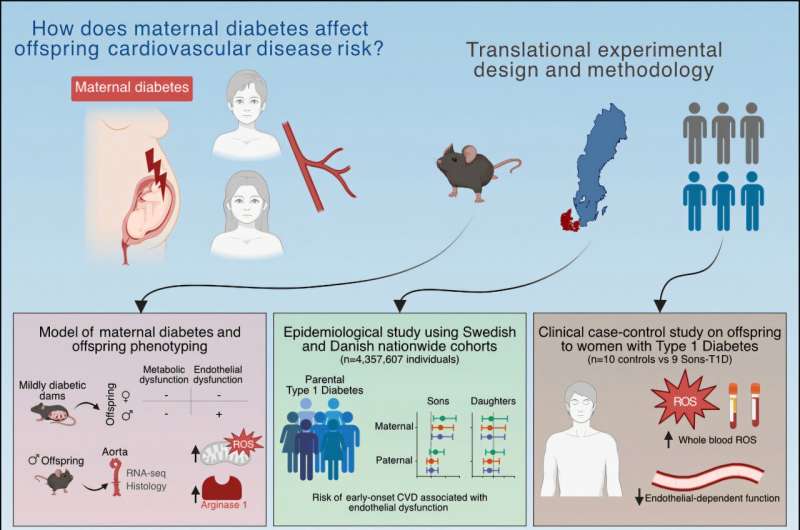
Graphical abstract. Credit:Cell Reports Medicine(2025). DOI: 10.1016/j.xcrm.2025.102454
A new study from Karolinska Institutet and Stockholm University reveals that sons born to mothers with type 1 diabetes may develop early vascular dysfunction—independently of metabolic health. The finding may help shape future strategies to prevent cardiovascular disease early in life.
Children of women with type 1 diabetes are known to be at increased risk of developing cardiovascular diseases. This new study,publishedinCell Reports Medicine, is the first to show that the risk is linked to early dysfunction in blood vessel cells in sons, even before any metabolic issues arise.
Researchers from the Department of Physiology and Pharmacology and collaborators used a combination of animal models, Swedish and Danish health registries, and a small clinical study to explore the link. Results show a sex-specific effect: only sons displayed early vascular changes.
"Our work shows thatvascular functionis affected before metabolic dysfunction appears, which challenges current assumptions," says Qiaolin Deng, researcher at Karolinska Institutet and Stockholm University and last author of the study.
The study found that the dysfunction is driven byoxidative stressin endothelial cells, a potential early sign of futurecardiovascular disease. The findings could help clinicians better assess risk and focus on preventive measures.
"We observed thatearly interventioncan restore vascular function in affected animals, pointing to new opportunities for disease prevention later in life," adds first author Allan Zhao, Ph.D. student at Karolinska Institutet and Stockholm University.
The team is now investigating the long-term effects of maternal diabetes, with a particular focus on why sons seem to be affected earlier than daughters.
More information: Allan Zhaoet al, Maternal diabetes programs sexually dimorphic early-onset cardiovascular dysfunction in metabolically healthy offspring, Cell Reports Medicine (2025). DOI: 10.1016/j.xcrm.2025.102454 . www.cell.com/cell-reports-medi … 2666-3791(25)00527-0 Journal information: Cell Reports Medicine
Provided by Karolinska Institutet








Post comments