




































byUniversity of Bonn
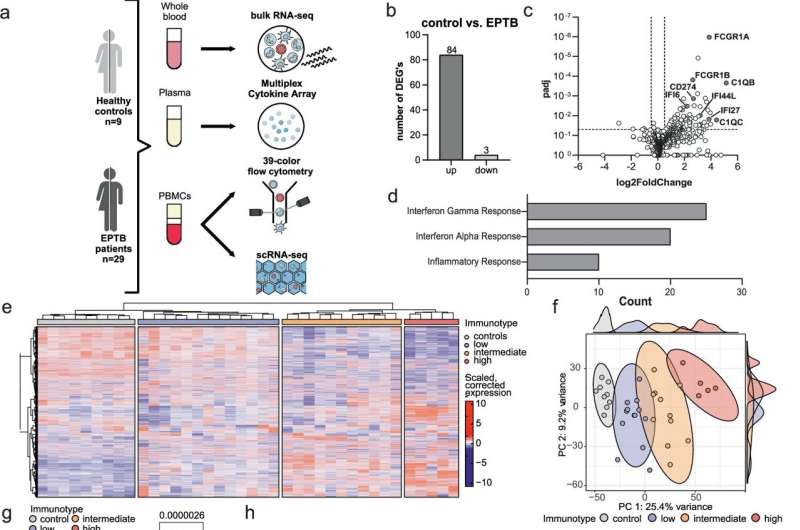
Whole-blood RNA-sequencing analysis for detection of EPTB immunotypes. Credit:Nature Communications(2025). DOI: 10.1038/s41467-025-65561-x
Tuberculosis (TB) is one of the world's most common infectious diseases. Although infection with the Mycobacterium tuberculosis bacterium primarily affects the lungs, up to 25% of all infected people will also have it in other parts of their bodies, such as their lymph nodes, bones or brain. Across the world, TB is contracted by about 10 million people every year, 1.25 million of whom will die as a result of their infection.
Up until now, however, theimmune responseto TB, and especially EPTB, has not been adequately understood. In some parts of the world, as many as 30% of TB sufferers have EPTB, which can affect every single organ outside the lungs. This makes diagnosis and treatment much harder, because there are no readily accessible biomarkers.
To gain a better understanding of the immunological processes at play, the researchers studied the blood of EPTB patients using state-of-the-art multi-omics approaches such as single-cell RNA sequencing of blood cells. Their analysis of transcriptome data revealed complex signaling networks between relevant parts of the immune system that play an important role in fighting pathogens and controlling inflammation.
The work ispublishedin the journalNature Communications.
Dr. Sebastian Theobald, first author of the study and research associate at the University Hospital Cologne, says, "The data has enabled us for the first time to assign EPTB patients to one of three distinct immunotypes that reflect different progressions of the disease."
Professor Jan Rybniker, head of the focus area for Clinical Infectious Diseases at the University Hospital Cologne and Deputy Coordinator of the TB Research Field at the DZIF, adds, "This dynamic is facilitating fresh insights into TB's disease mechanism and will hopefully enable us to give patients personalized and more effective treatment in the future."
Co-author Kilian Dahm, a bioinformatician at the University Hospital Bonn and the DZNE, contributed to the study's research during his doctorate at the University of Bonn: "In particular, the interaction between the interferon and interleukin-1 signaling pathways and the activation of T-cells andnatural killer cellsplayed a key role in identifying the immunotypes."
The researchers succeeded in developing gene-expression-based biomarkers that can diagnose both extrapulmonary and pulmonary TB reliably. As things stand, patients have to undergo a tissue biopsy to be diagnosed with EPTB. In the future, however, the identification of signatures based on immunological markers and gene-expression patterns in the blood could serve as readily accessible biomarkers for diagnosing EPTB and thus have a major impact on patient care.
Dr. Thomas Ulas is a bioinformatician at the DZNE and the LIMES Institute at the University of Bonn and a member of the University's ImmunoSensation2 Cluster of Excellence. He says, "Our findings will help improve TB diagnosis and treatment enormously and pave the way for targeted, tailored therapies."
Privatdozent Dr. Isabelle Suárez, a senior physician in Clinic I for Internal Medicine at the University Hospital Cologne, adds, "The clinical characterization of the patients was crucial to categorizing the molecular findings correctly and bridging the gap to clinical practice."
The findings on diagnosing molecular signatures in the blood of EPTB patients that have been gleaned from the investigations conducted to date are currently being subjected to further validation as part of a large-scale clinical cohort known as the mEx-TB study. Led by Rybniker and Suárez, it is based at several DZIF centers in Germany.
More information: Sebastian J. Theobald et al, Deep immune profiling delineates hallmarks of disease heterogeneity in extrapulmonary tuberculosis, Nature Communications (2025). DOI: 10.1038/s41467-025-65561-x Journal information: Nature Communications
Provided by University of Bonn







Post comments