




































by Amy Colgan,The Ohio State University
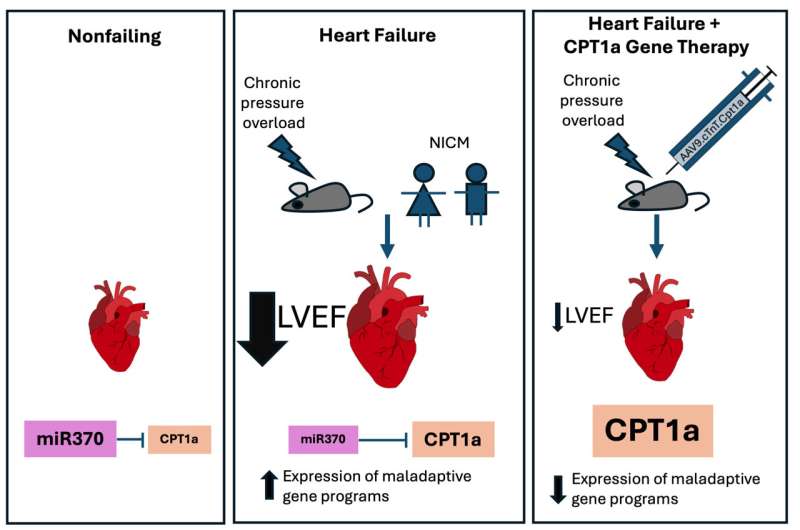
Credit:Circulation Research(2025). DOI: 10.1161/circresaha.125.327403
More than 64 million people worldwide live with heart failure, including 6.7 million Americans. Current treatment primarily consists of managing symptoms rather than addressing the underlying causes of heart failure progression.
Now, researchers at The Ohio State University College of Medicine have discovered a new way to help hearts recover from damage and stress. They found that when the heart is stressed, it naturally increases levels of carnitine palmitoyl transferase 1a (CPT1a), a protein that helps protect heart cells. They discovered that increasing CPT1a with gene therapy helps slow down heart failure even after the heart starts having problems.
The findings arepublishedin the journalCirculation Research.
"Given the mounting diagnoses of cardiomyopathy and heart failure—more than 500,000 every three years—a dire need exists for new treatments that suppress adverse remodeling in diseased hearts to improve function and outcomes. This novel gene therapy approach shows promise," said E. Douglas Lewandowski, Ph.D., senior author and director of translational research at Ohio State's Dororthy M. Davis Heart and Lung Research Institute.
Researchers studied human heart samples from the University of Pennsylvania and University of Utah to learn more about the protein CPT1. They compared two groups: unused healthy donor hearts and hearts from people with nonischemic cardiomyopathy (NICM), a type of heart disease. They found that in people with NICM, the amount of CPT1a was higher in both men and women. Another form, CPT1b, didn't change.
Scientists used animal models to determine if having more CPT1a in diseased hearts was helpful or harmful. They found mice that couldn't make enough CPT1a got sicker faster and had worse heart function. Using gene therapy to increase CPT1a in the heart helped mice recover even after heart failure had begun. Researchers also discovered that CPT1a not only helps the heart use energy but also turns off harmful genes that cause scarring and cell death.
Lewandowski and his team plan to continue testing CPT1a gene therapy in animal models and hope to move toward clinical trials in humans. They also aim to better understand how CPT1a controls genes that help the heart heal. Lewandowski and Andrew Carley, Ph.D., an Ohio State internal medicine research assistant professor, have applied for a patent for their gene therapy approach.
"This gene therapy has the potential to be a one-time therapy instead of chronic drug dosing," said Lewandowski, who is also the Jack M. George Chair in Medicine at Ohio State and professor of internal medicine in the divisions of Cardiovascular Medicine and Endocrinology.
More information Andrew N. Carley et al, Increased CPT1a Expression Is a Critical Cardioprotective Response to Pathological Stress that Suppresses Gene Programs for Remodeling and Enables Rescue by Gene Transfer, Circulation Research (2025). DOI: 10.1161/circresaha.125.327403 Journal information: Circulation Research
Provided by The Ohio State University







Post comments