




































by Ana María Rodríguez,Baylor College of Medicine
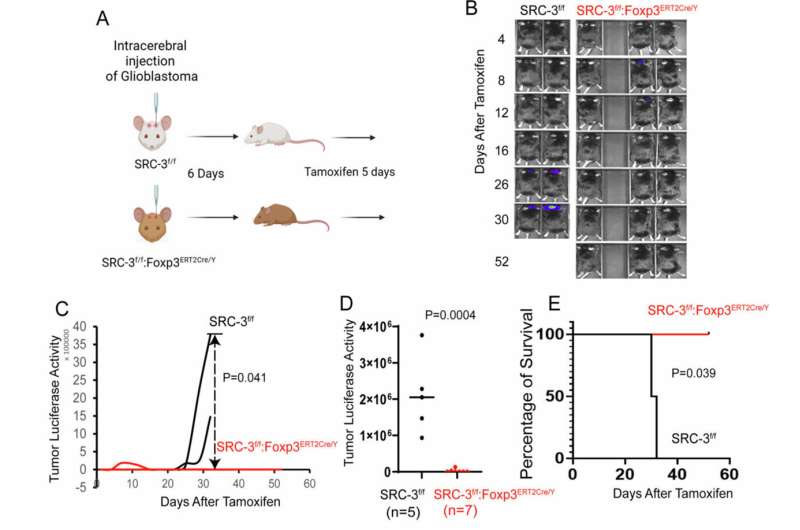
The loss of SRC-3 in Treg leads to immune suppression of glioblastoma in mice: (A) Experimental design for the orthotopic injection of glioblastoma cells (luciferase-labeled CT-2A) into the mouse brain, followed by tamoxifen treatment to induce SRC-3 KO Tregs. (B) In vivo imaging analysis of luciferase activity in glioblastoma-bearing SRC-3f/f(n= 2) and SRC-3f/f:Foxp3ERT2Cre/Y(n= 3) male mice treated with tamoxifen. (C) Quantification of luciferase activity in glioblastoma-bearing SRC-3f/fand SRC-3f/f:Foxp3ERT2Cre/Ymice from panel B. Each line represents a single mouse. (D) Tumor luciferase activity was measured across three independent experiments. The total number of mice used for the SRC-3f/fand SRC-3f/f:Foxp3ERT2Cre/Ygroups was 5 and 7, respectively. Luciferase activity was recorded for each mouse at the conclusion of the experiment. (E) Survival curve of SRC-3f/fand SRC-3f/f:Foxp3ERT2Cre/Ymale mice with glioblastoma. Credit:OncoImmunology(2026). DOI: 10.1080/2162402x.2026.2640261
In 2023, researchers at Baylor College of Medicine led by the late Dr. Bert O'Malleydiscoveredthat the steroid receptor coactivator 3 (SRC-3) in immune cells called regulatory T cells (Tregs) plays a decisive role in shaping the anti-cancer immune response and that this could potentially be leveraged to develop more effective, long-lasting, side effect-free cancer treatments. The researchers didn't stop there, and they now have more promising results to report ina paperinOncoImmunology.
Tregs and SRC-3: Main players shaping the anti-tumor immune response
Many solid tumors protect themselves by promoting an environment that suppresses the anti-tumor response mediated by cytotoxic T cells and natural killer cells. These so-called "cold" tumors contrast with "hot" tumors, which includeanti-tumor immune cellinfiltration.
To create a "cold" environment, some tumors recruit Tregs, which express SRC-3, a contributor to the immunosuppressive action of Tregs.
"Our 2023 paper showed in animal models of breast and prostate cancer that eliminating the gene SRC-3 in Tregs shifted these cells' actions from pro-tumor to anti-tumor, enabling them to infiltrate tumors and recruit cancer-fighting immune cells," said first author Dr. Sang Jun Han, Richard E. Buller Professor of molecular and cellular biology at Baylor. He also is a member of Baylor's Dan L Duncan Comprehensive Cancer Center.
"Lacking SRC-3 allowed Tregs to trigger an anti-cancer response that eradicated tumors without the typical side effects observed with other therapies and appeared to confer long-lasting protection against recurrence," said co-author Dr. David Lonard, professor of molecular and cellular biology and member of the Dan L Duncan Comprehensive Cancer Center at Baylor. "We also found that Tregs lacking SRC-3, also calledSRC-3 knockout(KO) Tregs, mediated tumor eradication by effectively modifying the environment surrounding the tumor into one that favored its elimination."
SRC-3 KO Tregs in tumor-bearing mice proliferated extensively and preferentially infiltrated breast tumors where they released chemo-attractants, compounds that generated an anti-tumor immune response. On one side, the chemo-attractants facilitated the entrance of immune cells—T cells and natural killer cells—that directly attacked the tumor, and—on the other side—modified Tregs blocked other immune cells that attempted to stop the anti-tumor response.
The researchers were excited about these results, which encouraged them to continue their investigations to translate the findings into a novel, improved cancer therapy. Their next step was to investigate the effects of SRC-3 KO Tregs on other solid cancers: glioblastoma, melanoma, and lung cancer—the focus of their current paper.
Glioblastoma: Complete response
Typically, the environment surrounding glioblastoma is immunologically "cold." The researchers investigated whether SRC-3 KO Tregs could turn this environment "hot." In mice with glioblastoma but without SRC-3 KO Tregs, tumors grew rapidly and none of the animals survived up to day 41 after tumor implantation. In contrast, mice with the tumor and SRC-3 KO Tregs showed complete suppression of glioblastoma growth and survived throughout the 52-day follow-up period.
"Moreover, we detected markedly increased infiltration of immune T cells in glioblastoma tissues from SRC-3 KO mice, indicating active immunological tumor attack," Han said. "This result demonstrates that SRC-3 KO Tregs convert the glioblastoma environment from one lacking tumor-fighting cells to one actively battling for its eradication."
Melanoma: Significant suppression
Melanoma typically has more tumor-fighting immune cells than glioblastoma, but still recruits Treg-mediated suppression to resist immune elimination. In a mouse model, all control mice developed tumors, whereas 75% of mice with SRC-3 KO Tregs remained tumor-free and survived beyond 50 days. As before, tumor-fighting immune cells infiltrated these melanoma tissues, highlighting a robust anti-tumor immune response.
Lung cancer: Long-term control
The lung cancer model showed that both control and SRC-3 KO Tregs groups initially experienced some tumor regression. However, only the control mice exhibited subsequent tumor resurgence, and all died within 32 days post-treatment.
In contrast, 60% of SRC-3 KO mice achieved long-term survival through complete tumor clearance, whereas 40% died without evidence of tumor recurrence. Similar to the other cancer models, researchers observed significantly elevated immune cell infiltration in lung tumor tissue from SRC-3 KO mice.
"Finding that we can extend the use of SRC-3 KO Tregs in animal models to eliminate or suppress other types of cancer, increase survival and turn 'hot' the tumor immune environment with cancer-fighting cells encourages us to continue this investigation to evaluate the value of this approach to treat human cancers," Han said. "SRC-3 is a promising therapeutic target for next-generation cancer immunotherapy."
Publication details Nuri Sung et al, Steroid receptor coactivator 3-deficient regulatory T cells eradicate multiple solid tumors in syngeneic mouse models, OncoImmunology (2026). DOI: 10.1080/2162402x.2026.2640261 Journal information: OncoImmunology








Post comments