




































by Miles Martin,University of California - San Diego
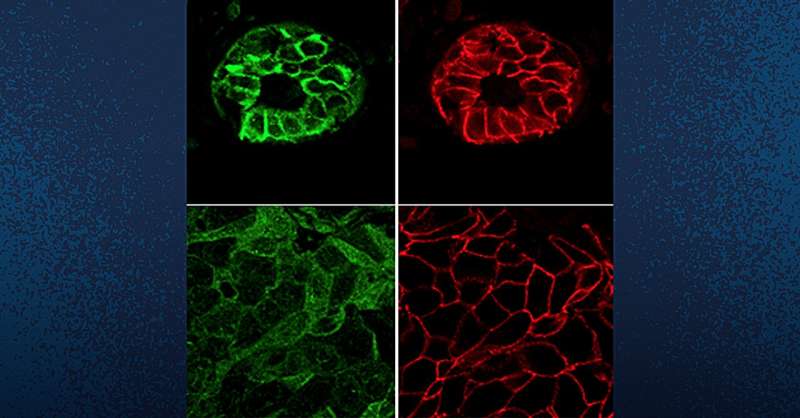
In healthy tissues, seen in the top two panels here, TYK2 (green) is found on the cell membrane and colocalizes with E-cadherin (red), a protein that helps maintain cellular adhesion and tissue integrity. In tumors, shown in the bottom two panels, TYK2 is spread throughout the cell and no longer colocalizes with E-cadherin. This phenomenon allows cancer cells to more easily spread. Credit: UC San Diego Health Sciences
A study by researchers at the University of California San Diego could make it easier to treat breast cancer by uncovering a new way the body helps prevent its spread. The scientists discovered a new role for an inflammatory protein called TYK2 in mechanotransduction, the process by which cells sense and respond to their physical environment. Understanding mechanotransduction can provide insights into how cancer spreads and provide new avenues for treatment.
Additionally, becausedrugs that inhibit TYK2are being explored as treatments for autoimmune diseases, the study, whichappearsinNature Communications, highlights the need to consider these drugs' impact on breast cancer progression.
The researchers found:
Understanding how TYK2 functions as a metastasis suppressor could pave the way for new treatments for breast cancer. The study's findings also suggest that patients with certain types of noninvasive breast cancer could be at higher risk of developing invasive breast cancer when receiving TYK2 inhibitors. This highlights the need for enhanced breast cancer screening in patients treated with TYK2 inhibitors.
"This study reveals how extracellular matrix stiffness regulates breast cancer metastasis through TYK2 and provides new insights into how physical cues in the tumor microenvironment control cancer progression," said Zhimin Hu, Ph.D., lead author of this study and a project scientist at UC San Diego Moores Cancer Center.
"Our findings have significant implications for the clinical use of TYK2 inhibitors and underscore the importance of considering the mechanical microenvironment in cancer therapy," said Jing Yang, Ph.D., corresponding author and professor of pharmacology at UC San Diego School of Medicine. Yang is also a member of Moores Cancer Center.
Publication details Zhimin Hu et al, Extracellular matrix rigidity controls breast cancer metastasis via TYK2-mediated mechanotransduction, Nature Communications (2026). DOI: 10.1038/s41467-026-70518-9 Journal information: Nature Communications









Post comments