




































by Elana Gotkine
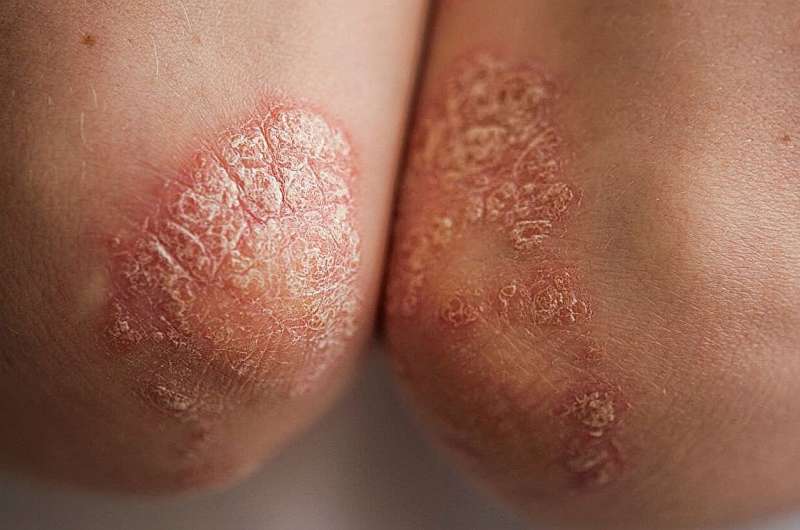
For patients undergoing total hip arthroplasty (THA), those with cutaneous psoriasis (PsC) and psoriatic arthritis (PsA) have an increased risk for complications, according to a study published online March 22 in theJournal of Arthroplasty.
In a retrospective database analysis, Jackson W. Durbin, from the George Washington University School of Medicine and Health Sciences in Washington, D.C., and colleagues compared the rates of superficial surgical site infections (SSI), deep SSI, 90-day sepsis rates, and two-year revision rates following THA in patients with PsC and PsA versus those without psoriasis. A total of 593,013 patients were included: 10,230 (1.7%) and 1,445 (0.2%) had PsC and PsA, respectively.
The researchers found that patients with PsC had higher 90-day rates of superficial SSI, deep SSI, wound complications, sepsis, and aseptic revision (odds ratios, 2.3, 1.4, 1.1, 2.8, and 1.2, respectively). Patients withPsAhad higher 90-day rates of superficial SSI, sepsis, and deep SSI (odds ratios, 1.7, 4.7, and 2.9, respectively). Both cohorts had highertwo-year all-cause revision(odds ratios, 1.2 and 1.1 for PsC and PsA, respectively).
"This study demonstrates that both manifestations of psoriasis are associated with significantly higher risks of postoperative infections," the authors write. "These results indicate that a multidisciplinary approach with perisurgical optimization and judicious infection control measures may be warranted to optimize outcomes in patients who have psoriasis of any type."
© 2026HealthDay. All rights reserved.
More information Jackson W. Durbin et al, Outcomes Following Total Hip Arthroplasty in Patients with Cutaneous Psoriasis and Psoriatic Arthritis, The Journal of Arthroplasty (2026). DOI: 10.1016/j.arth.2026.03.054










Post comments