

































byIngrid Fadelli, Medical Xpress
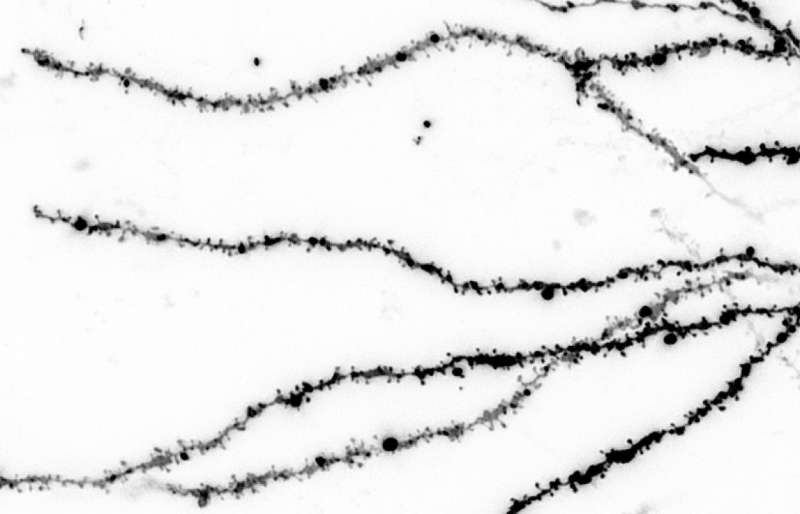
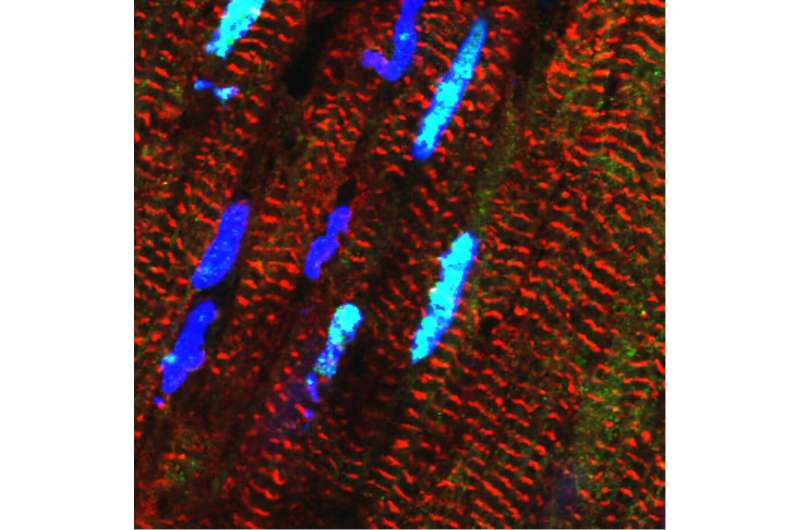
A close-up view of hippocampal neurons showing dendritic spines—the tiny structures through which neurons communicate. These microscopic connections are continuously remodeled by experience and are believed to play a key role in learning, memory, and social behavior. Credit: La Greca et al.
Humans and other animals can learn new skills and behaviors from others they interact with. This process, referred to as social learning, has been widely investigated in the past, particularly in the context of responses to threatening stimuli or social norms.
Researchers at Università degli Studi di Milano, Université Côte d'Azur and the National Research Council of Italy recently discovered that in addition to behaviors that can aid survival, mice can also learn prosocial behaviors from their peers.
Their paper,published inNature Neuroscience, suggests that a specific part of the brain, specifically thedorsal CA1(dCA1) region in the hippocampus, plays a key role in the learning of prosocial behaviors from others.
"To be honest, this project initially resulted from a mistake," Diego Scheggia, senior author of the paper, told Medical Xpress. "During a behavioral procedure, two mice were accidentally switched. The results we obtained were unexpected, but also very intriguing. They suggested that the mice were not simply learning by trial and error, but might have learned by watching their cage mates."
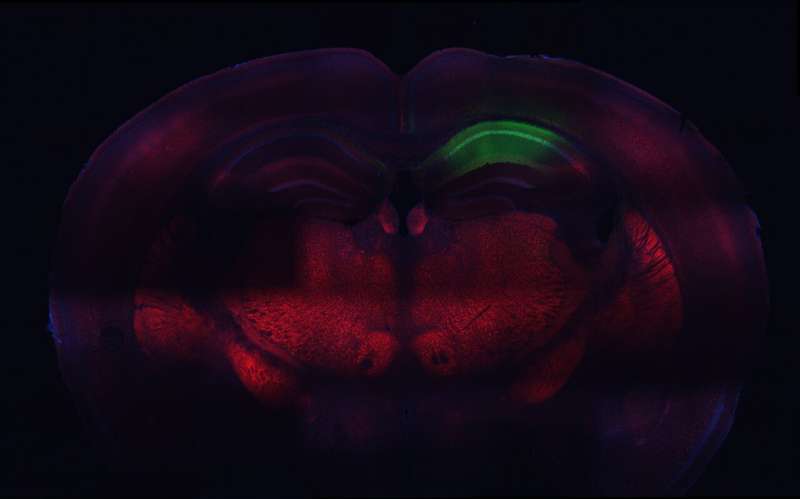
Coronal section of the mouse brain showing fluorescent labeling in the dorsal hippocampus (green), a region identified as a key neural substrate for observational social learning. Neural activity in this circuit encoded social information that shaped future prosocial decisions. Credit: La Greca et al.
Exploring how mice learn to behave supportively
After fortuitously observing that mice had learned to be socially supportive from their cage companions, Scheggia and his colleagues formulated a hypothesis that could be tested experimentally. Specifically, they hypothesized that mice could acquire prosocial behaviors by observing other mice.
To test this hypothesis, they devised anew behavioral paradigm, which they used in their experiments. Their paradigm entailed allowing a mouse to choose between obtaining a food reward only for itself or sharing it with another mouse.
"Other mice observed these interactions and were later tested to determine whether they had learned from what they had seen, a process called observational learning," explained Scheggia.
"To understand the brain mechanisms involved, we combined behavioral experiments with tools that allow us torecord and manipulatethe activity of brain cells. We specifically used techniques called fiber photometry to monitor the neural activity in real time, and optogenetics and chemogenetics, tools that allow researchers to selectively increase or decrease the activity of specific groups of neurons."
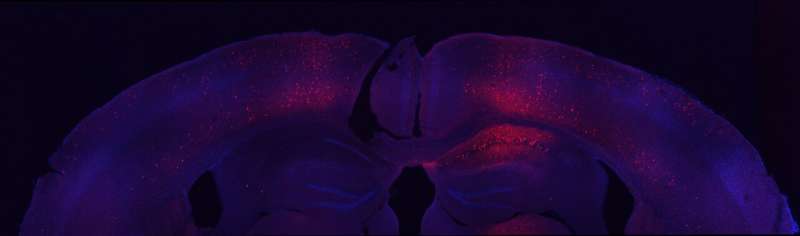
Coronal section of the mouse brain showing fluorescent activated cells (red) in the dorsal hippocampus, during observational social learning. Neural activity in this circuit encoded social information that shaped future prosocial decisions. Credit: La Greca et al.
Using this combination of experimental techniques, Scheggia and his colleagues found that theCA1 areain the dorsal hippocampus plays a role in observational learning. The dCA1 appeared to induce long-term changes in the brain via a process known as synaptic plasticity.
"We found that neural activity in this region while the mice were observing others predicted whether they would later behave in a more prosocial or more selfish way," said Scheggia. "Importantly, by experimentally manipulating this activity, we could also orient the animals' future social choices."
Implications for the study of empathy and cooperation
This study introduces a new behavioral paradigm that can be used to study the social learning of prosocial behaviors in mice. In the future, other researchers could adapt this paradigm and conduct further experiments aimed at validating the team's findings.
"I think the most important contribution is that we show that prosocial behavior can be socially learned and is not merely expressed instinctively or acquired through direct experience," said Scheggia. "The observer mice did not simply imitate; they learned the relationship between another animal's action and its consequences, and they could adapt this knowledge in a flexible way."
The findings gathered by Scheggia and his colleagues suggest that individual differences in the prosocial or selfish behavioral tendencies of mice are associated with specific patterns of activity in the dCA1 region. This indicates that the mouse brain actively interprets social experiences, building internal representations that guide the animals' future behavior.
If they are validated in humans, the team's observations could have interesting implications for the study of empathy, cooperation and other types of human prosocial traits or behaviors. In addition, they might help to better understand developmental conditions or mental health disorders characterized by an inability to learn prosocial skills from others.
"Our next goal is to understand how these hippocampal representations interact with broader brain networks involved in social behavior, motivation, and decision-making," added Scheggia.
"We are also interested in whether similar mechanisms are altered in conditions where learning from others is compromised, including neurodevelopmental, aging-related, or neurodegenerative disorders. More generally, we would like to understand how the brain transforms observed social information into future actions: why the same experience leads some individuals toward cooperation and others toward more selfish choices."
© 2026 Science X Network
Publication details Filippo La Greca et al, Individual differences in prosocial learning are represented in the hippocampal dorsal CA1, Nature Neuroscience (2026). DOI: 10.1038/s41593-026-02292-2 . Journal information: Nature Neuroscience






Post comments