




































byIngrid Fadelli, Medical Xpress
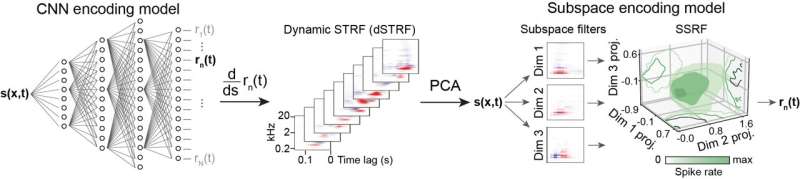
Mapping from convolutional neural network (CNN) to subspace encoding models. A population CNN model predicts time-varying neural activity recorded at a single site during presentation of a natural sound library. A dynamic STRF (dSTRF) is the collection of locally linear approximations of the CNN, computed as the gradient of the CNN response relative to the stimulus spectrogram. The neuron's tuning subspace is estimated by principal components analysis (PCA) of the dSTRF across all timepoints. The subspace receptive field (SSRF) is then the mean response to stimuli at each point in the tuning subspace. Credit: Wingert et al.
Over the past decades, computer scientists have introduced numerous artificial intelligence (AI) systems designed to emulate the organization and functioning of networks of neurons in the brain. Recently, some of these models have also proved useful for studying the brain, its underlying neural mechanisms, and how it supports specific functions.
Using deep learning models—advanced AI algorithms that can identify patterns in large amounts of data—a team of researchers at Oregon Health and Science University and University of Rochester set out to better understand how the brain processes and decodes patterns in sounds.
The insight they gathered,published inNature Neuroscience, suggests that different types of neurons in the brain play distinct roles in sound coding, responding to specific sound features.
"My lab has a long-standing interest in understanding the computations performed by the auditory system to extract meaningful information from natural stimuli," Stephen David, Professor at Oregon Health & Science University and senior author of the paper, told Medical Xpress.
"Our approach is to use neural encoding models, which measure the functional relationship between the spectrogram of a large number of sound stimuli and the corresponding neural response."
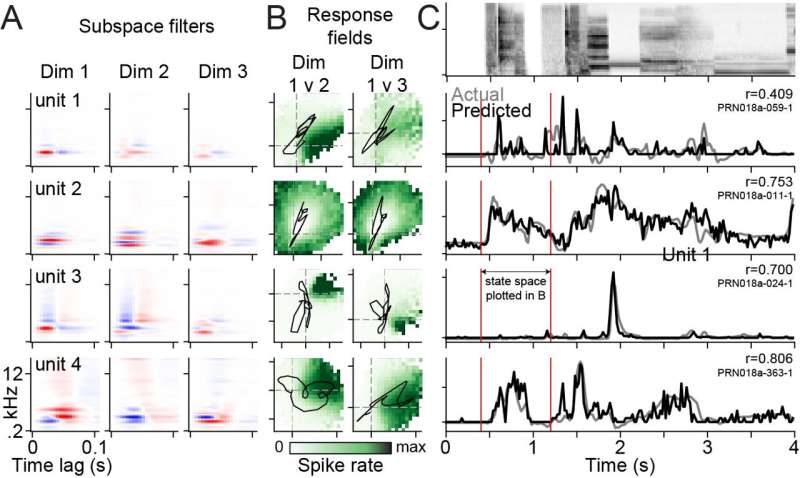
Diversity of subspace models within a single auditory cortex (AC) recording site. A. Three largest-variance subspace filters for four example units, all span similar spectrotemporal domains. B. Two-dimensional subspace receptive fields (SSRFs) for dimensions 1 vs. 2 (left) and 1 vs. 3 (right), computed as the average predicted response to stimuli at each point in the tuning subspace. Darker green indicates higher spike rate. Black lines show trajectory of stimuli in the subspace during the 0.4–1.2 sec stimulus epoch. C. Top row shows 4-sec segment of spectrogram from the natural sound sequence used to test prediction accuracy. Each row below shows the predicted PSTH response (black) overlaid with the actual response (gray). r indicates model prediction accuracy for that unit (prediction correlation), highlighting the unique selectivity of each unit. Credit: Wingert et al.
Studying the brain with deep learning models
Recently, David and his colleagues started developing new deep learning-based models, computational models that can independently learn to predict how neurons in the brain respond to specific sensory inputs. Their new method produced models that were far easier to interpret than those of neural encoding models they developed in the past.
"The problem with the deep learning models has been that they are quite complex, so we haven't been able to figure out what computations explain their improved performance," explained David.
As part of their recent study, the researchers developed a brain-inspired deep learning model called a convolutional neural network (CNN). They trained this model on the recorded activity of individual neurons in the auditory cortex, the main brain region involved in the processing of sounds. Notably, these recordings were collected while animals listened to a wide range of natural sounds.
The CNN was trained end-to-end, which means that it was not previously trained on a separate sound dataset. After this training process, the model was able to predict the activity of neurons in the auditory cortex in response to different sounds, while also offering insight about what features of sounds activated specific neurons.
"The key insight of the current study was that we could use the trained models to measure the family of sound features that drove the activity of a single neuron," said David.
"This was accomplished by measuring many locally linear approximations of the model input-output relationship (kind of like a spline fit to the large CNN) and then performing PCA across those approximations. This produced a small number of sound features, which we termed the 'stimulus subspace' that influences the neural activity."
By studying patterns in their deep learning model's predictions, the researchers were ultimately able to uncover specific features of sounds that activated different populations of neurons.
Overall, their study suggests that when processing natural sounds, groups of cells in the auditory cortex analyze different features separately,
"Using this subspace analysis, we were able to identify systematic differences in encoding properties between neurons in different layers of cortex as well as between neurons with regular and narrow spikes (putative excitatory and inhibitory neurons)," said David.
"We also found evidence that a population of nearby neurons in theauditory cortextend to share the same subspace, but their selectivity within that subspace is highly disjointed, producing a sparse code of incoming natural sounds. This sparse code has been hypothesized to support feature recognition."
New insight and future research avenues
The findings gathered by David and his colleagues highlight the potential of deep learning algorithms for studying how different brain regions process specific types of sensory information.
While their recent study focused specifically on the decoding of auditory stimuli, the same deep learning-based method could soon be used to study the processing of visual cues or other sensory information.
In the future, these efforts could shed new light on the intricate processes that allow the human brain to make sense of the world, while also supporting different advanced functions, such as attention, memory, reasoning, and decision-making. In addition, they might pave the way for the development of new AI systems that closely mirror how the brain processes information.
"We are now looking for collaborators to test the subspace analysis in different sensory modalities," added David. "In my own lab, we are interested in understanding how changes in behavioral state influence sound encoding and are developing multimodal CCNs that integrate sound processing and behavioral state."
© 2026 Science X Network
Publication details Jereme C. Wingert et al, Convolutional neural network models describe the encoding subspace of local circuits in auditory cortex, Nature Neuroscience (2026). DOI: 10.1038/s41593-026-02216-0 . Journal information: Nature Neuroscience









Post comments