




































by Melissa Rohman,Northwestern University
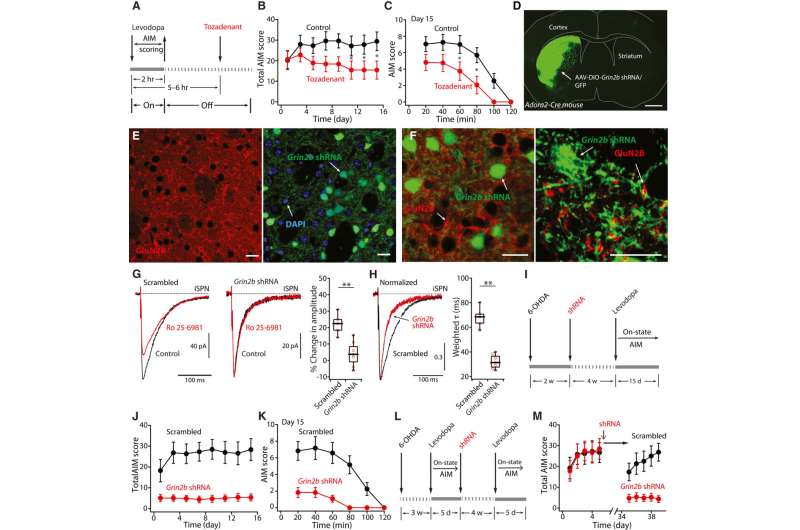
Antagonism of A2aR and knockdown of GluN2B-NMDARs in iSPNs attenuate LID behaviors. Credit:Neuron(2026). DOI: 10.1016/j.neuron.2026.04.023
Northwestern Medicine scientists have discovered that suppressing excitatory synaptic transmission in a small group of neurons in the brain may reverse levodopa-induced dyskinesia in patients with late-stage Parkinson's disease without reducing the symptomatic benefits of levodopa treatment, according to a recent studypublishedinNeuron.
"This study shows that levodopa-induced dyskinesia depends uponaberrant glutamatergic synaptic transmissionin a subset of striatal neurons in the brain. Moreover, using a novel gene therapy to correct synaptic function, we were able to reverse established dyskinesia, which is the clinically relevant goal," said D. James Surmeier, Ph.D., the Nathan Smith Davis Professor and chair of Neuroscience, who was senior author of the study.
According to the World Health Organization, approximately 8.5 million people currently live with Parkinson's disease. The disease, which is progressive and can cause tremors, muscle stiffness and slow movement, is characterized by theloss of dopaminergic neuronsin the midbrain that, under normal conditions, send signals to the brain to coordinate goal-directed movement and habit.
Most patients with late-stage Parkinson's disease will also develop levodopa-induced dyskinesia (LID)—involuntary movement associated with taking the first-line medication levodopa, which converts to dopamine in the brain and serves as a dopamine replacement.
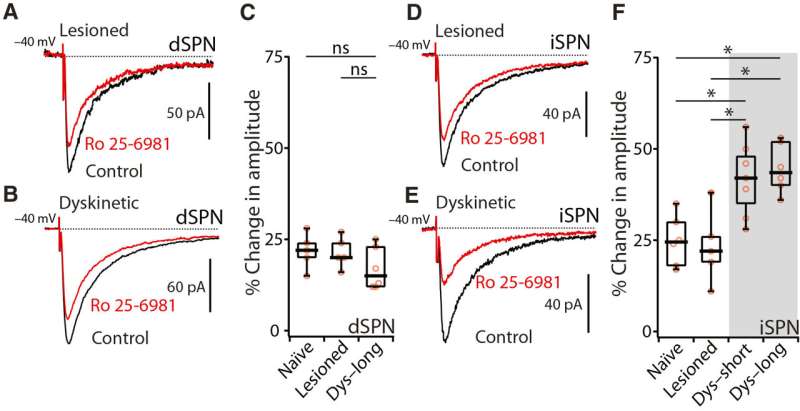
GluN2B-preferring inhibitor suppresses more NMDAR currents in levodopa-treated iSPNs than in untreated iSPNs. Credit:Neuron(2026). DOI: 10.1016/j.neuron.2026.04.023
As the disease progresses, the number of dopaminergic neurons in the midbrain declines and higher doses of levodopa are needed to alleviate disease symptoms. However, increasing the dose oflevodopatriggersaberrant synaptic plasticityin striatal neurons.
"Levodopa-induced dyskinesia is a consequence of aberrant synaptic plasticity. That is, levodopa disrupts the strength of the connections between the cortex and the striatum. These connections between neurons dictate when they become active and how they perform their duties in controlling movement," Surmeier said. "In late-stage patients, levodopa begins to 'scramble' these connections, which we think leads to uncontrolled movement or dyskinesia."
In the current study, Surmeier and his team used molecular, cellular and behavioral strategies in a mouse model of levodopa-induced dyskinesia (LID) to uncover the mechanisms promoting changes in neuronal circuits that underlie major side-effects of symptomatic treatment.
They discovered that inducing LID caused an upregulation of GluN2B-containing N-methyl-D-aspartate (NMDA) receptors in indirect pathway spiny projection neurons (iSPNs), a key class of striatal GABAergic neurons controlling movement.
"When we induce dyskinesia, we see this change in NMDA receptors in this subset of striatal neurons thought to be responsible for suppression of unwanted movement," Surmeier said.
This finding then prompted the investigators to hypothesize what would occur if they inhibited the upregulation of NMDA receptors. They found that knocking down the expression of GluN2B mRNA in iSPNs in mice not only prevented LID development, but also reversed it once established.
"What was very exciting was that—in contrast to almost everything else that has been tried in the last 30 years—knocking down this one NMDA receptor subunit in this particular group of cells reversed established dyskinesia," Surmeier said.
The findings suggest targeting GluN2B-containing NMDA receptors in iSPNs may be a promising genetic therapy approach for LID and serve as an alternative option to surgical intervention, such as deep-brain stimulation, Surmeier said.
"We show thatsystemic administrationof a specially designed viral vector could achieve the same endpoint as stereotactic surgery. This raises the possibility of a gene therapy for LID that wouldn't involve brain surgery," Surmeier said.
Surmeier said he is now organizing an international consortium that will pursue this therapeutic approach to determine whether it could be used in humans.
"This is a way that we might be able to control dyskinesia with a completely novel strategy," Surmeier said. "Nearly 80% of Parkinson's disease patients will develop dyskinesia. At present, we have a very limited set of tools to help these patients right now. This work points to the possibility of a non-invasive gene therapy that would be transformative."
Publication details Cell- and state-specific plasticity of striatal glutamatergic synapses is critical to the expression of levodopa-induced dyskinesia, Neuron (2026). DOI: 10.1016/j.neuron.2026.04.023 . www.cell.com/neuron/fulltext/S0896-6273(26)00318-1 Journal information: Neuron










Post comments