




































by Amit Arora, Hannah Dahlen, Jessica Appleton, Lynn Kemp,The Conversation
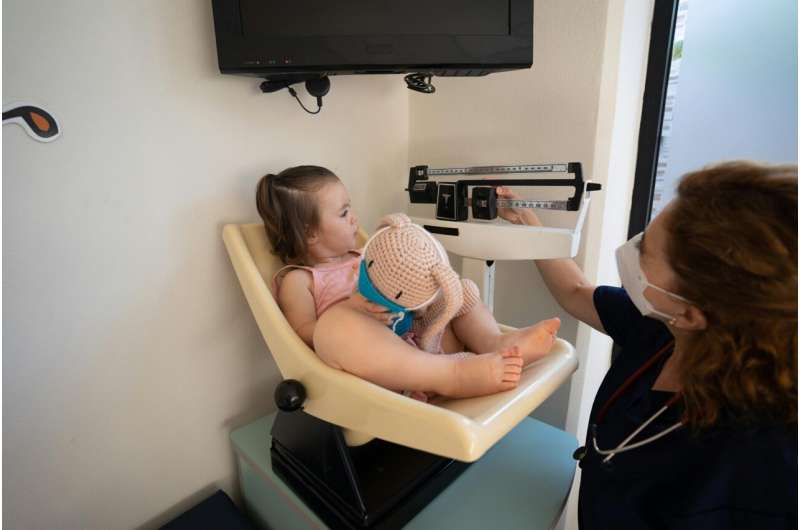
Credit: Los Muertos Crew from Pexels
If you've ever taken your child to a maternal, child and family health nurse for a growth check, you might have felt a mix of curiosity and anxiety.
As health professionals, we're often asked: is my baby gaining enough weight? Am I feeding enough? Why did they drop a percentile? Why is my friend's baby bigger than mine? Am I doing something wrong?
In most cases, the answer is that there is nothing wrong at all. Let's look at what the measurements actually mean and we'll answer some questions that commonly arise during these appointments.
What actually happens at a growth check?
Growth checks are usually done by amaternal, child and family health nurseat a community health center, or by your family GP.
Each state and territory, as well asNew Zealand, has itsown scheduleof recommended growth and development checks. InVictoria, for example, appointments are booked when your baby is aged two weeks, four weeks, eight weeks, four months, eight months, 12 months, 18 months, two years, and three and a half years.
In the early weeks, when feeding is still being established and child growth is rapid, these appointments can help identify feeding difficulties.
First, the nurse will observe your baby or child, then they will weigh them, measure their length (if they're babies) or height, and measure their head circumference. They plot these numbers on a growth chart in your child'shealth recordor theWell Child Tamariki Ora bookin New Zealand.
The nurse will check your child's alertness, appearance and muscle tone. They will also ask questions about feeding, sleep, wet/dirty nappies and any recent changes.
Nurses are there to support you as a new parent. They provide reassurance and a chance to ask questions to help build confidence during a period that can feel uncertain.
Over time, growth checks allownursesto see if your child is growing anddevelopingat an expected rate.
For toddlers and preschoolers, the nurse will check for typical development inbehavior, language and play. If required, they will provide support or referrals to a GP who may then refer to a pediatrician, speech pathologist, occupational therapist, or psychologist, depending on the child's needs.
What do the dots on a growth chart really mean?
Growth chartsin Australia and New Zealand are based on the World Health Organization's Child Growth Standards, which reflect optimal growth for healthy, breastfed children.
They provide context for your child's growth through a reference population of children of the same age and sex. The curved lines are called percentiles.
If your child is on the 25th percentile for weight, it means that if 100 children of the same age and sex were lined up in increasing order of weight, your child would be number 25. So 75 children would weigh more and 24 would weigh less.
A single measurement tells very little. The pattern of the weight over time is even more important.
But there is no "ideal" percentile. Every child grows at their own pace and this can be influenced by theirgenetics,ethnicity,birthweightandgestation. Evensiblings or twinsmay follow different patterns.
When should parents be concerned?
Small fluctuations on thechartare common, as babies grow in spurts. But nurses may look more closely if a child:
Even in these cases, the approach is careful assessment, not alarm, and your nurse might suggest additional checks. This helps see whether a feeding adjustment is working, or whether something else might need attention.
In most cases, extra visits end with reassurance. When there is a concern, extra visits allow things to be identified and addressed early.
3 common questions answered
1. When should I consider supplementing with formula?
Breastfeedingis recommended where possible. But there are situations where supplementing with formula might be recommended—for example, when there are concerns about weight gain. In these cases, we always recommendto discuss supplementingwith your trusted health care provider.
Your nurse is there to support your child and reassure you—not to judge how you feed them.
2. Should I start solids early if my baby is 'big'?
In short, no. The guidelines recommend introducing solids ataround six months. This should be done when babies show developmental readiness, not because of their size or percentile.
Breastmilkor formula still meets all nutritional needs until around six months.
Startingsolids earlymay increase risks ofchoking, tummy upset and a greater chance of beingoverweight later in life.
3. Why doesn't growth happen steadily week to week?
Babies grow in spurts, not in smooth lines and weight can vary with feeding, sleep and any recent illness.
Periods ofrapid growthoften occur in the early weeks, around six to eight weeks, three to four months, and around six months with babies growing rapidly throughout thefirst year of life. During these times, babies may feed more or seem unsettled.
This article is republished fromThe Conversationunder a Creative Commons license. Read theoriginal article.
Key medical concepts Breastfeeding Head Circumference










Post comments