




































byElsevier

Credit: Kindel Media from Pexels
A largescale, comprehensive study has found that individuals with attention-deficit/hyperactivity disorder (ADHD) are at increased risk of being convicted of crimes compared to those without ADHD, and that this association extends to their relatives, suggesting shared familial factors such as genetics and environmental conditions.
Thenew studyinBiological Psychiatryemphasizes the need for timely support to help reduce impulsive or risky behaviors that might otherwise escalate. It suggests that understanding familial patterns encourages clinicians to be more attentive to ADHD symptoms in relatives, thereby helping to interrupt cycles across generations.
ADHD affects 5% to 7% of children and adolescents worldwide, and about 2.5% of adults. Characterized by impaired attention, hyperactivity/impulsivity, or both, ADHD is associated with adverse outcomes, including elevated risk of crime.
Meta-analyses show that individuals with ADHD are 2–3 times more likely to be arrested, convicted, or incarcerated, often at a younger age and with higher rates of reoffending. Additionally, about 25% ofincarcerated individualsmeet diagnostic criteria for ADHD, far exceeding general population rates. However, the link between ADHD and criminality remains poorly understood.
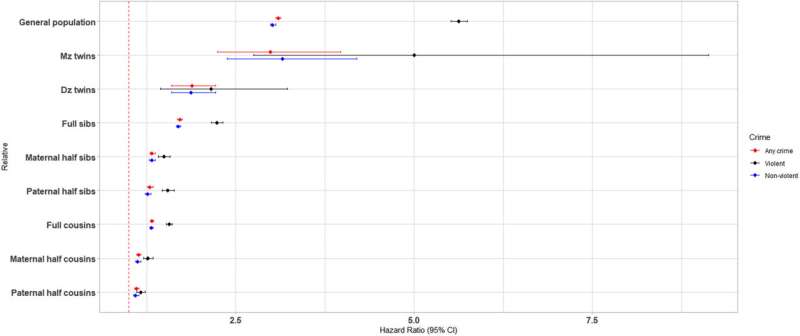
Hazard ratios for any, violent, and non-violent criminal convictions in the general population and familial co-aggregation estimates. Credit:Biological Psychiatry(2025). DOI: 10.1016/j.biopsych.2025.10.007
John Krystal, MD, Editor ofBiological Psychiatry, comments, "We have long known that ADHD puts people at risk for risky, impulsive behaviors, including crime. We have also been aware that ADHD risk has a genetic component. This important paper now brings these threads together to show that families that carry ADHD risk are also at risk for having family members who engage in criminal activity. These data highlight the importance of early identification and treatment of ADHD in high-risk families to mitigate this risk."
UsingSwedish national registrydata, investigators followed more than 1.5 million people born between 1987 and 2002, linking medical diagnoses of ADHD to official crime records. They then compared risks of criminal convictions both within individuals and across multiple degrees of relatedness: twins, siblings, half-siblings, and cousins.
"We found that individuals with ADHD were several times more likely to have criminal convictions for bothviolent and non-violent crimes. Importantly, relatives of individuals with ADHD also showed increased risk, even if they themselves did not have ADHD, pointing to shared familial liability. The associations were to some extent stronger among women than men, indicating possible sex-specific factors in how ADHD relates to criminal outcomes," explains lead investigator Sofi Oskarsson, Ph.D., School of Behavioral, Social and Legal Sciences, Örebro University, Sweden.
"Because ADHD may be underdiagnosed or mischaracterized in females, the higher relative risk among women may indicate that when ADHD does occur, it reflects a more severe or concentrated set of underlying risk factors."
The researchers point out that this study was conducted in Sweden, a high-income Western country with universal health care and relatively low incarceration rates. Cultural, legal, and health care system differences may influence both ADHD detection and conviction likelihood. However, a systematic review ofworldwide ADHD prevalencesuggests that rates are relatively consistent across regions when comparable diagnostic criteria are applied.
"This indicates that our findings may extend beyond Western context, although studies in underrepresented regions are clearly warranted to confirm the generalizability of co-aggregation patterns," says Dr. Oskarsson.
The findings of the study highlight that preventive and intervention strategies should be implemented for both sexes, while also addressing potential sex-specific mechanisms and the additional challenges faced by females with ADHD, including stigma and late detection. Early identification and treatment of ADHD, especially in families with a history of ADHD, could play a critical role in mitigating associated risks.
Dr. Oskarsson concludes, "At a time when awareness of ADHD is increasing, understanding the broader familial patterns helps us recognize ADHD not only as an individual challenge but also as part of a family-level risk profile. These insights are critical for informing early intervention and support strategies that could reduce negative outcomes like criminality."
More information Sofi Oskarsson et al, The Familial Co-Aggregation of ADHD and Criminal Convictions: A Register-Based Cohort Study, Biological Psychiatry (2025). DOI: 10.1016/j.biopsych.2025.10.007 Journal information: Biological Psychiatry










Post comments