



























byGeorge Washington University
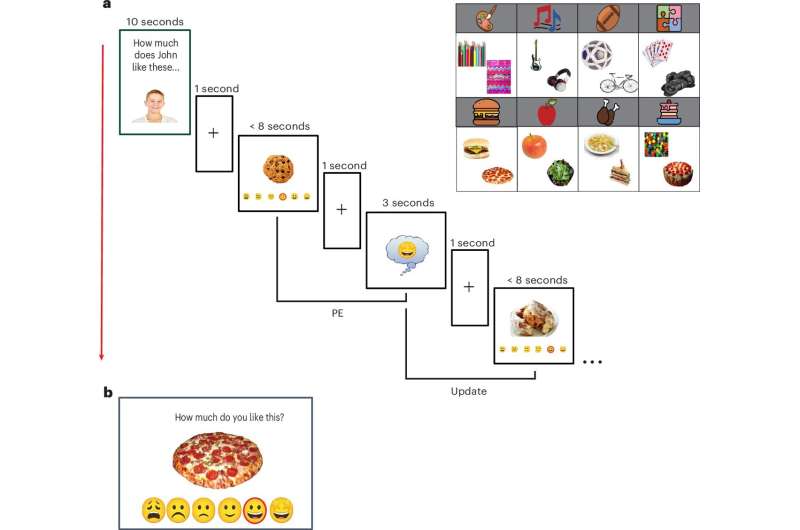
Preference learning paradigm. Credit:Nature Mental Health(2026). DOI: 10.1038/s44220-026-00650-4
New research from the George Washington University has yielded some unexpected insights into how autistic and non-autistic people learn about one another's preferences. The study indicates that both groups rely on similar learning strategies; however, key differences may help us understand how autistic and non-autistic peers understand one another.
The research, led by Gabriela Rosenblau, associate professor of cognitive neuroscience and director of the Cognitive Neuroscience Doctoral Program, and her Ph.D. student Shannon Cahalan, examines whether autistic and non-autistic adolescents apply different types of social knowledge and learning strategies when inferring the preferences of others.
The paper, "Modeling how autistic and non-autistic groups learn about their own and each other's preferences," waspublishedinNature Mental Healthon June 2, 2026.
The team recruited large samples of autistic and non-autistic individuals who participated in an online study. In the first experiment, they captured participants' personal preferences for certain food and activities. Next, they compared how non-autistic adults and autistic adolescents inferred the food and activity preferences of both autistic and non-autistic adolescents.
The study found that:
"These results suggest that misunderstandings between autistic and non-autistic people may not stem from fundamentally different learning mechanisms," said Rosenblau. "Instead, they may arise because autistic individuals' preferences are more varied, making them harder to predict using typical social assumptions."
The findings offer new evidence for the "double empathy problem," a theory which suggests that communication barriers between autistic and non-autistic people arise from differences in how each group interprets the social world, rather than from a lack of empathy in autistic individuals.
According to Rosenblau, the work highlights the value of combining large datasets with computational modeling to better understand social learning in autism. The framework may also help researchers identify meaningful differences within the autism spectrum that could inform future interventions.
Publication details Shannon Cahalan et al, Modeling how autistic and non-autistic groups learn about their own and each other's preferences, Nature Mental Health (2026). DOI: 10.1038/s44220-026-00650-4 Journal information: Nature Mental Health






Post comments