




































By Elsevier
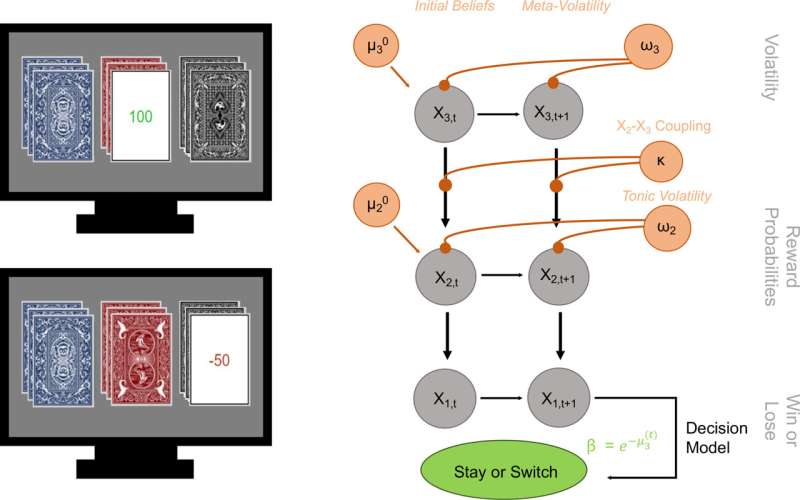
Image of 3PRL task and Hierarchical Gaussian Filter model. Volatility priors are represented in the model as μ30. Credit:Biological Psychiatry: Cognitive Neuroscience and Neuroimaging(2026). DOI: 10.1016/j.bpsc.2026.06.013
New research has found that reductions in the severity of delusions in patients with schizophrenia-spectrum disorders recovering from an acute psychotic episode were significantly associated with reductions in volatility priors—someone's expectations about the unpredictability of their environment. The findings from thenew study, published inBiological Psychiatry: Cognitive Neuroscience and Neuroimaging, suggest that volatility priors are modifiable, pointing to a potential novel treatment target.
As the most common psychotic symptom, delusions are strongly held beliefs that persist despite contradictory evidence and can cause significant distress and disability for millions of people around the world. Defined by the DSM-5 as "beliefs based on false inference," there is limited knowledge about how these false inferences arise. Previous research suggests that delusional thinking may be related to how people experience volatility priors in their environment.
In schizophrenia-spectrum disorders, the brain's volatility prior is often set abnormally high, so patients expect the world to be unpredictable, chaotic and unstable even when it is not. To make sense of this, the brain generates delusions, which can be devastating to patients and families and contribute to social isolation, suicidality, incarceration and functional disability. Current clinical approaches offer variable and often poor treatment options.
"Patients deserve more effective treatments," said lead investigator Julia M. Sheffield, Ph.D., of Vanderbilt University Medical Center's Department of Psychiatry and Behavioral Sciences. "We sought to extend previous cross-sectional research and ask whether these volatility priors change alongside delusion severity, suggesting a state marker (temporary condition) that could be modified with treatment, or whether they are stably elevated in patients prone to delusions, suggesting a trait marker (permanent vulnerability) that could be a target for prevention."
For the study, 75 adults with schizophrenia-spectrum disorders recovering from an acute psychotic episode that included delusional thought content were recruited from an inpatient psychiatric hospital. Researchers assessed volatility priors and delusional thinking at six time points over six months. Data were compared with a nonclinical control group of 71 individuals. To estimate volatility priors, participants performed a probabilistic reversal learning task, which was analyzed using computational modeling.
At the beginning of the study, participants with schizophrenia-spectrum disorders had significantly elevated volatility priors compared with the control group. The severity of delusional thinking, paranoia and volatility priors remained elevated at the end of the six-month study period among participants with schizophrenia-spectrum disorders, never fully normalizing. Critically, volatility priors were longitudinally associated with delusional thinking and paranoia, but not with depression or worry.
Results remained unchanged after controlling for antipsychotic medication and baseline cognitive ability. There is also some evidence of stronger associations with delusions of a paranoid/persecutory theme, consistent with previous work.
Longitudinal assessment of a cognitive process using a behavioral paradigm can be challenging because of practice effects. People can learn the task and improve their behavior as a result of task exposure rather than a fundamental change in their cognitive state. Although investigators worked to mitigate it, their findings are confounded by this effect. However, patients continued to show elevated volatility priors at six months, at their sixth exposure to the task.
This provided some validation that the task was not simply being overlearned, but rather that the task and modeling scheme were sensitive to volatility priors above and beyond practice effects.
"Leveraging the unique opportunity to recruit schizophrenia-spectrum disorder participants with delusions during an acute psychiatric episode and follow them over time, we demonstrate that volatility priors—a computational marker of belief updating—are significantly elevated at baseline, reduce over time and longitudinally relate to the severity of specific, well-characterized clinical delusions," Sheffield said.
"These data suggest that volatility priors are a state-sensitive cognitive marker of delusional thinking that can change with recovery, making them potential candidates for treatment development to improve clinical delusions."
Historically, delusions have been treated broadly with antipsychotic medications that dampen dopamine systems. By identifying that volatility priors are elevated at baseline and reduce over time in relation to reductions in delusion severity, this study provides foundational evidence that adjusting someone's expectations about the volatility or unpredictability of their environment is a potential new treatment target.
Sheffield concluded, "These findings are an exciting step in understanding the mechanisms of delusions and lay the groundwork for bridging computational psychiatry and clinical treatment. Psychological interventions, such as cognitive behavioral therapy for psychosis, can incorporate this knowledge to develop novel treatments, promoting recovery from a disabling and distressing symptom of serious mental illness. The ultimate task is to improve the lives of patients and families."
Editor-in-chief ofBiological Psychiatry: Cognitive Neuroscience and NeuroimagingCameron S. Carter, MD, of the University of California Irvine School of Medicine, added, "This research represents the first time that volatility priors have been assessed longitudinally in psychotic disorders during recovery. By tracking these changes over six months, the investigators provide the most comprehensive picture yet of how this underlying brain mechanism drives the severity of delusions."
More information Julia M. Sheffield et al, Longitudinal associations between volatility priors and delusions in individuals recovering from an acute psychotic episode, Biological Psychiatry: Cognitive Neuroscience and Neuroimaging (2026). DOI: 10.1016/j.bpsc.2026.06.013










Post comments