



































by Torsten Lauer,Central Institute of Mental Health
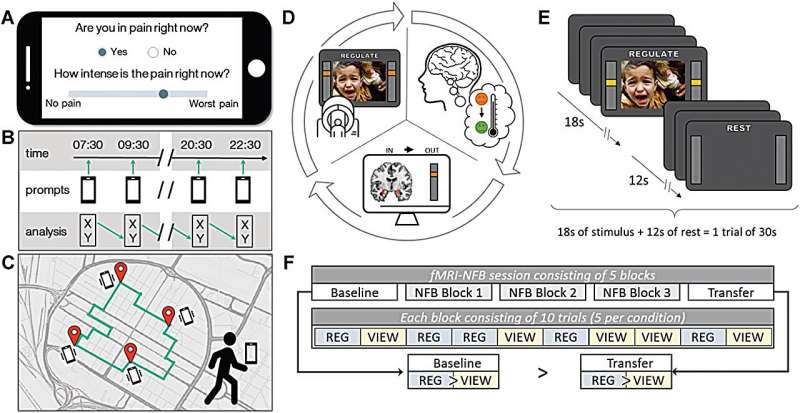
Schematic of EMA and fMRI neurofeedback method. Credit:Pain(2025). DOI: 10.1097/j.pain.0000000000003800
A new study led by the Central Institute of Mental Health shows that people with depression and fibromyalgia exhibit nearly identical patterns of impaired emotional regulation and that stress significantly worsens pain and mood in both groups. The findings highlight the close interconnection between pain, stress, and emotions and underscore the importance of psychotherapeutic treatment approaches.
Fibromyalgia is a chronic pain disorder characterized by widespread discomfort in muscles, tendons, and ligaments. Like depression, it is one of the most common causes of severe impairment in everyday life. Both conditions often occur together and can exacerbate each other.
A recent study involving researchers from the Central Institute of Mental Health (CIMH) in Mannheim, the Heidelberg and Mannheim Medical Faculty of Heidelberg University, and the University Hospitals of Heidelberg and Mainz shows that patients with fibromyalgia, like people with depression, suffer from comparable difficulties in regulating their emotions.
They brood more, blame themselves more often, and have problems controlling their emotions appropriately. Stress acts as a central amplifier in this process: It exacerbates both pain and depressive moods.
"Our data clearly show that pain and mood are inextricably linked and that difficulties in emotion regulation characterize both clinical pictures," says Prof. Dr. Dr. Heike Tost, head of the Systems Neuroscience in Psychiatry (SNiP) working group at the CIMH and last author of the studypublishedinPain.
A clear correlation was evident in everyday life. Stressful situations not only led to a worse mood, but also to a significant increase in pain intensity. This was observed in people with fibromyalgia as well as in people with depression. Many sufferers experience this vicious circle on a daily basis.
In order to comprehensively map these interactions, the researchers combined several methods. The participants answeredscientific questionnaires, reported on their current state of health several times a day via smartphone, and underwent MRI scans. Among other things, this revealed how well they were able to regulate their emotional responses and how active theamygdalawas in this process. The amygdala is a central brain region for the evaluation of emotional stimuli.
People withfibromyalgiaalso showed increased sensitivity in the areas of the brain that process pain. This provides a possible explanation for why pain is often experienced more intensely and persistently in this group. "Stress increases pain, and pain increases stress. Understanding this interaction is an important step toward effective treatment," says Prof. Dr. Andreas Meyer-Lindenberg, Director of the CIMH and Medical Director of the Clinic for Psychiatry and Psychotherapy.
The study demonstrates the high relevance of psychotherapeutic methods that specifically target improving emotion and stress regulation. Such approaches could further improve treatment for both chronic pain and depression.
Building on the latest findings, a follow-up study is now being launched to test an innovative brief intervention for stress reduction. The method is based on EMDR (Eye Movement Desensitization and Reprocessing) and uses eye-guided desensitization to reduce emotional stress more quickly. The aim is to examine whether this can specifically influence dysregulation in the brain and break the vicious cycle of pain and stress in the long term.
More information Malika Pia Renz et al, Neural, psychological, and daily life evidence for a transdiagnostic process of affective dysregulation in depression and chronic widespread pain, Pain (2025). DOI: 10.1097/j.pain.0000000000003800 Journal information: Pain











Post comments