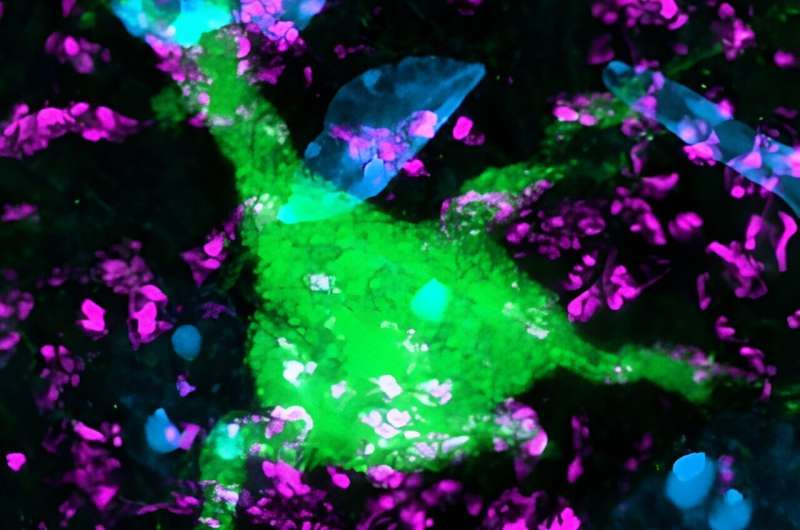






























by Champalimaud Centre for the UnknownAn artistic interpretation of the research. The bright algae represent mossy fibers—brain connections that interact with pufferfish, symbolizing the cerebellar nu
by Society of Nuclear MedicineCredit: Pixabay/CC0 Public DomainResearchers have developed a new method for triggering and imaging seizures in epilepsy patients, offering physicians the ability to
by American Academy of NeurologyCredit: Pixabay/CC0 Public DomainOlder people with hypothyroidism, also called underactive thyroid, may be at increased risk of developing dementia, according to a
by Lori SolomonPatients with dementia have markedly increased risks for psychiatric disorders before dementia diagnosis, according to a study published online Oct. 17 inJAMA Network Open.Minjia
byEcole Polytechnique Federale de Lausanneα-Syn(gS87) PFFs have diminished ability to induce pathology formation, spreading and toxicity in cells and in vivo.a, Primary embryonic hippocamp
by Lauren Baggett,University of GeorgiaCredit: CC0 Public DomainLast summer, the U.S. Food and Drug Administration fully approved the first drug shown to slow the progress of Alzheimer's. Bu
(HealthDay)—The nomination of former U.S. Food and Drug Administration head Robert Califf, M.D., to again lead the agency now heads to the full Senate for a vote, after a Senate committee on Thursday
byWolters Kluwer HealthCredit: Pixabay/CC0 Public DomainChronic pain affects approximately 60% of people living with traumatic brain injury (TBI), even up to 30 years after injury, according to&
by Laval UniversityFRET ratio is independent of laser intensity, and imaging depth was comparable between NonTg and 5xFAD mice. (A) Confocal image of the AAV2/9.CaMKIIa.SuperClomeleon (SCLM) infe
by Amy Cherry,University of DelawareStroke survivor Larry Christian (center) participates in high-intensity interval training in a clinical trial while research assistant Henry Wright (right) ob
by Max Planck SocietyHow can we shift from a state of inattentiveness to one of highest attention? Scientists at the Max Planck Institute for Human Development and the University of Southern Cali