




































by Åsa Catapano,Karolinska Institutet
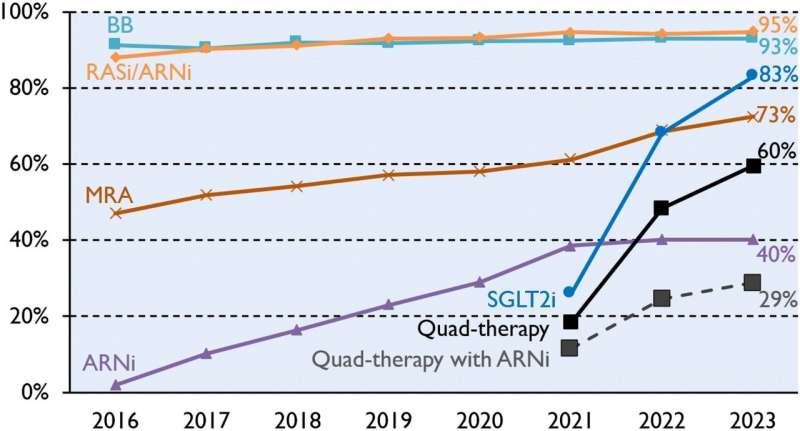
Implementation of guideline-directed medical therapy over time. ARNi, angiotensin receptor–neprilysin inhibitor; BB, beta-blocker; GDMT, guideline-directed medical therapy; MRA, mineralocorticoid receptor antagonist; RASi, renin–angiotensin system inhibitor; SGLT2i, sodium–glucose co-transporter 2 inhibitor; Quad, quadruple. Credit:European Heart Journal(2026). DOI:10.1093/eurheartj/ehag199
An increasing proportion of patients with heart failure receive a combination of four medications shown to improve prognosis and recommended in guidelines. However, there is still room for improving adherence and persistence to heart failure therapy, which appears linked to a lower risk of hospitalization for heart failure and cardiovascular death. These findings are shown by a new study from Karolinska Institutetpublishedin theEuropean Heart Journal.
The study included 35,215 individuals with heart failure with reduced ejection fraction (HFrEF) registered in the national quality registry for heart failure, the Swedish Heart Failure Registry (SwedeHF), between 2016 and 2023. The four drug classes—beta-blockers, ACE inhibitors/ARBs or ARNI, MRA, and SGLT2 inhibitors—have been shown to improve prognosis and are recommended for all patients with HFrEF. The researchers examined how many receive all four recommended drug classes and how well patients adhere to treatment, based on dispensed prescriptions.
The results show that the use of all four drug classes increased over the period. In 2023, 93% used beta-blockers, 95% ACE inhibitors/ARBs or ARNI, 73% MRA, and 83%SGLT2 inhibitors. Six out of 10 patients used all four medications.
"We see a clear improvement over time. At the same time, there is still room to increase the use of MRA in particular, which is the least used treatment," says senior author Gianluigi Savarese, Head of the Center for Heart Failure and Arrhythmia at the Department of Clinical Science and Education, Södersjukhuset.
High adherence linked to better prognosis
For the combination of all four treatments, good adherence was observed in 85%. The proportion who continued their medication after one year ranged between 77% and 90% for the individual treatments.
Good adherenceto the drug classes was linked to a lower risk of hospitalization due to heart failure or cardiovascular death.
SwedeHF, which is made possible by health care staff across the country, has contributed to many insights into how heart failure treatment is used in Sweden.
"Ten years ago, studies fromSwedeHFshowed that the use of heart failure treatment was limited and not increasing. It is therefore important that we can now show that improved use and adherence are achievable in routine clinical care, although there is still room to improve both prescription and adherence," says first author Felix Lindberg, postdoctoral researcher at the Department of Clinical Science and Education, Södersjukhuset.
Publication details Felix Lindberg et al, Heart failure with reduced ejection fraction in Sweden: patient adherence and persistence to quadruple pharmacotherapy prescription, European Heart Journal (2026). DOI: 10.1093/eurheartj/ehag199 . academic.oup.com/eurheartj/adv … artj/ehag199/8567990 Journal information: European Heart Journal











Post comments